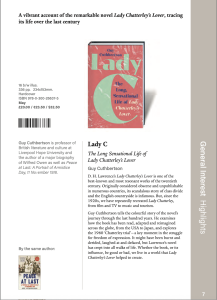
Lady C
Lady C: The Long, Sensational Life of Lady Chatterley’s Lover

*
My next book, about Lady Chatterley’s Lover, will be published in May 2026.
(336 Pages, 155 × 234 mm, 16 b-w illus.)
A vibrant account of the remarkable novel Lady Chatterley’s Lover, tracing its life over the last century
D. H. Lawrence’s Lady Chatterley’s Lover is one of the best-known and most resonant works of the twentieth century. Originally considered obscene and unpublishable in numerous countries, its scandalous story of class divide and the English countryside is infamous. But, since the 1920s, we have repeatedly re-created Lady Chatterley, from film and TV to music and tourism.
Guy Cuthbertson tells the colourful story of the novel’s journey through the last hundred years. He examines how the book has been read, adapted, and reimagined across the globe, from the United States to Japan, and explores the 1960 “Chatterley trial”—a key moment in the struggle for freedom of expression. It might have been burnt and derided, laughed at and defaced, but Lawrence’s novel has crept into all walks of life. Whether the book, or its influence, be good or bad, we live in a world that Lady Chatterley’s Lover helped to create.
Yale University Press USA
Yale University Press UK
Yale Representation
Amazon UK
Amazon USA
Goodreads
Blackwell’s
‘Erudite, informative and told with humour. I loved this account of the explosive arrival and embattled aftermath of a literary sensation – and of the response from an outwardly prudish, inwardly prurient public. Lawrence’s ‘dirty little book’ has changed the world.’—Cal Flyn, author of Islands of Abandonment
“Shrewd, even-handed, and frequently amusing, Lady C is a gleefully exhaustive survey of reactions to one of the world’s most argued-over narratives.”—Robert Crawford, author of Eliot After the Waste Land
“Guy Cuthbertson’s ‘life story’ of Lady Chatterley’s Lover is an intricate and engaging history of one of the most famous books in English literature. From its creation to its many afterlives, Cuthbertson deftly weaves a colourful biography of Lawrence’s novel whose cultural resonance lies not only in its plot, but in its legal and popular reception across the decades.”—Jane Potter, author of Wilfred Owen

© National Portrait Gallery, London. D.H. Lawrence
possibly by Lady Ottoline Morrell, vintage snapshot print, 1928
3 1/8 in. x 2 1/8 in. (78 mm x 54 mm) image size
Photographs Collection NPG x140424
‘If you could only tell them that living and spending isn’t the same thing! But it’s no good. If only they were educated to live instead of earn and spend’
(Lady Chatterley’s Lover)

The roaring and swaying was overhead, only cold currents came down below. Connie was strangely excited in the wood, and the colour flew in her cheeks, and burned blue in her eyes. She walked ploddingly, picking a few primroses and the first violets, that smelled sweet and cold. And she drifted on without knowing where she was.
Till she came to the clearing, at the far end of the wood, and saw the green-stained stone cottage, looking almost rosy, like the flesh underneath a mushroom, its stone warmed in a burst of sun. And there was a sparkle of yellow jasmine by the door; the closed door. But no sound; no smoke from the chimney; no dog barking.
She went quietly round to the back, where the bank rose up; she had an excuse, to see the daffodils.
And they were there, the short-stemmed flowers, rustling and fluttering and shivering, so bright and alive, but with nowhere to hide their faces, as they turned them away from the wind.
(Lady Chatterley’s Lover)