Recent publications
Some recent publications:
- Peace at Last: A Portrait of Armistice Day, 11 November 1918 (Yale University Press, 2018, pbk 2022), 300pp. And audiobook.
- ‘The Day the World Turned Upside Down’, BBC History Magazine (November 2018), Supplement: 24-page Armistice Magazine, pp. 4-9.
- ‘The Armistice bacchanal’, The New Statesman (4 November 2018), pp. 42-3.
- ‘Let us see to it that we guard the peace’, The Tablet (10 November 2018), pp. 4-5.
- ‘The Day of Victory: Gloucestershire and its Poets at the Armistice’, Dymock Poets and Friends (2019), pp. 101-4.
- ‘”I should want nothing more”: Edward Thomas and simplicity‘, Journal of the British Academy (November 2019), open access (reprinted in The Edward Thomas Fellowship Newsletter, 83, January 2020).
- ‘The Tolkiens of Solihull School’, 2020, available here.
- ‘Capturing Home: British First World War Poetry’, British Literature in Transition, 1900-1920: A New Age?, ed. James Purdon (Cambridge University Press, 2022), pp. 122-35.
- ‘“Pike, Popler, Oram, and Fatt”: Exploring Churchyards, Graves and Epitaphs with Edward Thomas’, Edward Thomas Fellowship Newsletter, 87 (January 2022), pp. 26-8.
- ‘“That remoter, changeless England”: Walter de la Mare and Edward Thomas’, Walter de la Mare: Critical Appraisals, ed. Yui Kajita, Angela Leighton and A.J. Nickerson, Liverpool English Texts and Studies, 95 (Liverpool University Press, 2022), pp. 77-94.
- ‘Edward Thomas and the Mundays of East Meon’, Edward Thomas Fellowship Newsletter, 89 (January 2023), pp. 16-21.
- ‘Edward Thomas (1878-1917)’, A History of World War One Poetry (Cambridge: Cambridge University Press, 2023), pp. 350-64.
- ‘“Unteaching”: Thomas on teaching, and teaching Thomas’, Edward Thomas Fellowship Newsletter, 94 (August 2025), pp. 52-4.
- review of Ralph Pite, Edward Thomas’s Prose: Truth, Mystery, and the Natural World, The Review of English Studies (January 2026).
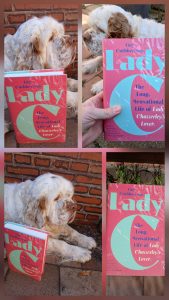
- Lady C: The Long, Sensational Life of Lady Chatterley’s Lover (Yale University Press, 2026).
‘My wife Caroline and I, and Morris the dog, visited Upper Barns last year. It was all beautiful, late on a sunny, late-summer day – half five in September, not a soul about, the new barns beneath the old trees, the red tractor put to bed for the night, a bonfire smoking gently somewhere down the lane. […] But back in 1908, it was a cold Christmas. They all slept on straw. Cattle shared the yard. There was no toilet or kitchen, no furniture; they had one blanket and one quilt; and the only water was the pond where the cows drank. The Mundays tried to get a cottage in the village but ‘people did not care about letting them in’, so the baby, Herbert Sidney, was born in the barn.’
(‘Edward Thomas and the Mundays of East Meon’)
‘De la Mare is the poet for all those people who hate their job, who dread the commute in the morning, who daydream at work, who come home and sit up late into the night, looking out of a suburban window at half a moon over rows of dirty dark-red houses, yearning for other worlds, other lives, daydreaming about some moonlit flit, longing for the countryside.’
(‘“That remoter, changeless England”: Walter de la Mare and Edward Thomas’)